
We independently test and review fitness products using a research-based approach. If you buy through our links, we may earn a small commission at no extra cost to you. Read our Disclosure
For the past three years, my “gym” has been a garage, two kettlebells, and a rubber mat that’s slowly peeling at the edges. No cable machines. No fancy mirrors. No $200/month membership. Just iron and repetition.
I tried programming workouts in a notebook. I followed random YouTube circuits. I downloaded printable PDFs promising “explosive fat loss.” That worked — for a while. Then I plateaued. The problem wasn’t effort; it was structure.
That’s when I began seriously testing kettlebell workout apps. Not casually. Not for one session. I used them for months at a time, tracking strength progress, recovery, and consistency.
After testing more than a dozen platforms, I narrowed the list down to the best kettlebell workout apps that actually help you train smarter, avoid plateaus, and build real strength.
In 2026, fitness apps are smarter than ever. They sync with wearables, analyze recovery data, and some even generate workouts automatically using AI. But not all platforms are equal; finding the best kettlebell workout apps requires looking past the marketing and into the actual programming logic.
This guide breaks down the best kettlebell workout apps in 2026, how they work, and which ones are worth using if you want structured, effective training at home.
Table of Contents
Quick Picks: Best Kettlebell Workout Apps in 2026
If you don’t want to read the entire guide, here are the top kettlebell workout apps based on real training experience, ease of use, and programming quality.
| App | Best For | Free Version | Platform |
|---|---|---|---|
| Fitbod | AI-generated workouts | Trial | iOS / Android |
| Strong Workout Tracker | Strength logging | Limited | iOS / Android |
| Hevy | Social workout tracking | Limited | iOS / Android |
| Aaptiv | Audio coaching | Trial | iOS / Android |
| Nike Training Club | Free guided workouts | 100% Free | iOS / Android |
The 2026 Fitness App Landscape: What’s Changed?
Five years ago, most fitness apps were glorified timers. In 2026, the best kettlebell workout apps offer sophisticated ecosystem integration that fundamentally changes how we train in our garages.
1. Personalized Programming
Modern apps no longer give you a static list of exercises. They adapt based on:
- Your logged workouts: If you crushed your 24kg swings on Monday, the app knows to push the volume on Wednesday.
- Muscle recovery patterns: Using “Freshness” algorithms to ensure you aren’t overtraining your lower back.
- Equipment availability: Some platforms will build an entire hypertrophy program around a single 16kg kettlebell.
2. Wearable Integration
Most serious apps now sync with smartwatches, chest strap heart monitors, and fitness trackers. They track Heart Rate Variability (HRV) and intensity zones. When used correctly, this data improves long-term progression and prevents the “burnout” often seen in high-intensity kettlebell circuits.
How to Choose the Best Kettlebell Workout Apps
Not all fitness apps are designed for kettlebell training. Some focus on bodybuilding, while others are built for HIIT circuits or cardio tracking.
When evaluating the best kettlebell workout apps, pay attention to these four features that separate professional tools from basic timers.
1. Progressive Overload Tracking
Strength training only works if you gradually increase difficulty over time. The best apps allow you to log:
- weight
- sets
- reps
- rest times
Apps like Strong Workout Tracker excel at detailed strength tracking.
2. Smart Programming
Some apps automatically build workouts based on your previous sessions. For example, Fitbod analyzes fatigue levels and rotates muscle groups to prevent overtraining.
This is especially useful for kettlebell workouts that heavily tax the lower back.
3. Exercise Demonstrations
Beginners benefit from video or audio coaching. Apps like Nike Training Club include high-quality demonstrations that teach proper form for swings, presses, and squats.
4. Simplicity
The best workout app is the one you actually use consistently. A clean interface often beats complicated features.
Best Kettlebell Workout Apps of 2026: Detailed Reviews
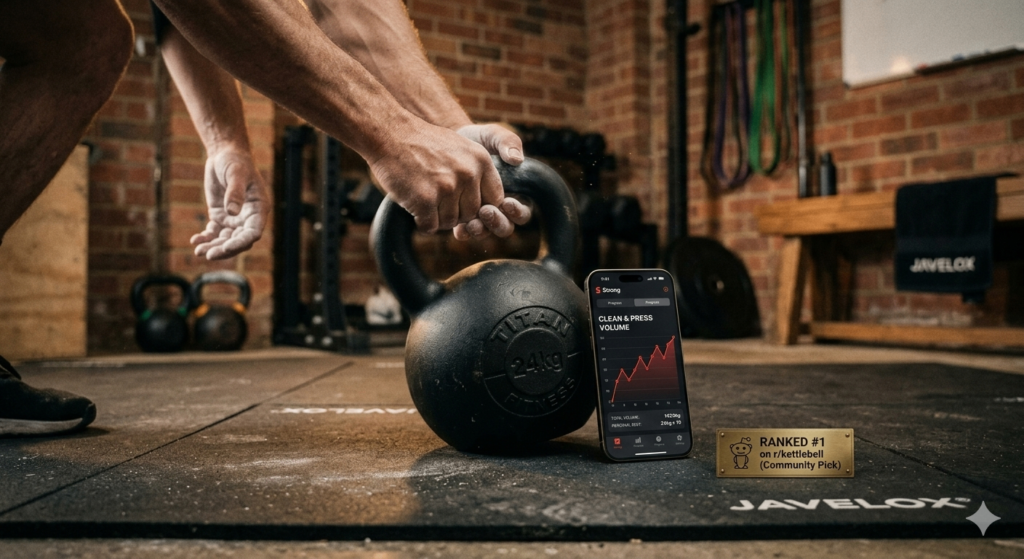
1. Strong – Best for Minimalist Strength Tracking
When I train heavy kettlebell days, this is what I open. Swings. Clean & Press. Turkish Get-ups. No distractions, no motivational quotes. Just your workout data.
- Logging Experience: You can quickly add sets, adjust reps, and log weight. It includes all major kettlebell movements.
- Pros: Fastest interface for logging; excellent long-term volume tracking.
- Cons: No built-in programs; you must bring your own routine.
2. Fitbod – Best AI-Generated Programs
Fitbod removes decision fatigue. It analyzes past workouts and fatigue levels to build a routine automatically.Its ability to adjust to your specific garage setup makes it one of the best kettlebell workout apps for home-based athletes.
- Safety: It rotates muscle groups strategically to reduce repetitive strain on the lower back.
- Pros: Zero planning required; adapts to the equipment you have on hand.
- Cons: Requires a subscription for the best features.
3. Hevy – Best for Social Accountability
Hevy blends strength tracking with community interaction. Friends can view your workouts, comment, and compete on leaderboards.
- Pros: Highly motivating social feed; great web-based dashboard.
- Cons: Can be distracting if you prefer a solo, quiet focus.
4. Aaptiv – Best Audio-Only Coaching
Looking down at your phone mid-swing is dangerous. Aaptiv provides guided audio sessions, allowing you to focus entirely on the “snap” of your hips.
- Pros: Audio-first design is safer for ballistic moves like snatches.
- Cons: Harder to track specific weight/rep PRs compared to Strong.
5. Nike Training Club – Best Free Content
If budget is your primary constraint, NTC is the gold standard for free, high-quality video production and expert-led routines.
Cons: Lacks the “Progressive Overload” data tracking of paid apps.
Pros: 100% Free; high-quality video demonstrations. It remains the gold standard for those seeking the best kettlebell workout apps without a monthly subscription fee.
The Science of the “Girya”: Biomechanics and Longevity
The word “Girya” first appeared in a Russian dictionary in 1704. Originally used as market counterweights, they are now recognized as the ultimate longevity tool.
1. The Physics of the Offset Mass
Unlike a dumbbell, where the center of mass sits in your palm, a kettlebell’s mass sits 4–6 inches away from the handle. This creates a “lever arm” that forces your stabilizer muscles (rotator cuff and deep core) to work 2–3x harder to maintain balance. Biomechanical studies show that this off-center distribution enables unique functional movement patterns that traditional weights simply cannot replicate.
2. Hip Hinge vs. The Squat
The most common mistake in kettlebell training is “squatting” the swing.
- The Hinge: Hips move backward, shins stay vertical, and hamstrings load like a bowstring.
- The Squat: Knees bend deeply and hips drop vertically.
Research published in the Journal of Strength and Conditioning Research highlights that the “hip-hinge” creates a rapid muscle activation-relaxation cycle that restores back health. Using an app that coaches this hinge correctly is the difference between a strong posterior chain and a disc injury.
3. Grip Strength: The 2026 Biomarker
In 2026, medical professionals treat grip strength as a primary biomarker for biological age. According to recent longevity data from National Geographic, a strong grip is a better predictor of cardiovascular health than blood pressure. Because every kettlebell movement requires a “crush grip” to manage the shifting weight, it is the most efficient tool for maintaining heart health and cognitive function as you age.
Why Kettlebell Training Is So Effective
Kettlebell training has remained popular for centuries because it combines several fitness benefits in one tool.
Full-Body Muscle Activation
Most kettlebell exercises require coordination between multiple muscle groups. Movements like swings, cleans, and snatches activate the glutes, hamstrings, core, shoulders, and grip simultaneously.
This makes kettlebells one of the most efficient tools for full-body strength training.
Cardiovascular Conditioning
High-rep kettlebell movements elevate heart rate quickly. A properly structured kettlebell workout can deliver both strength training and cardiovascular conditioning in a single session.
This is why kettlebell circuits are frequently used in CrossFit-style conditioning workouts.
Functional Strength
Unlike isolated machine exercises, kettlebell movements train the body to generate power through natural movement patterns. Hip hinges, presses, and carries mimic real-world movements, which improves overall athletic performance.
Because of this, kettlebells are widely used by athletes, martial artists, and military training programs.
Advanced Programming: S&S 2.0, Complexes & Chains
Many of the best kettlebell workout apps in 2026 have moved beyond random circuits to include sophisticated protocols like ‘Density’ training and Complexes.
1. Kettlebell Simple & Sinister (S&S 2.0)
Many 2026 apps now include the “Simple & Sinister” protocol by Pavel Tsatsouline.
- The Routine: 100 One-Arm Swings and 10 Turkish Get-ups daily.
- The Goal: Build a “fighter’s physique” and a “blue-collar grip” through monastic simplicity.
2. Complexes vs. Chains
Kettlebell Chains: A sequence where you do 1 rep of each move (1 Swing + 1 Clean + 1 Squat = 1 rep) and repeat. Chains are superior for developing coordination and “flow.”
Kettlebell Complexes: A series of moves performed back-to-back without setting the bell down (e.g., 5 Swings, 5 Cleans, 5 Squats). This is the gold standard for metabolic stress.
The Simple & Sinister (S&S 2.0) Quick-Start Checklist
- [ ] 100 One-Arm Swings: 10 sets of 10. Aim for 5 minutes total.
- [ ] 10 Turkish Get-Ups: 5 sets of 1 rep per arm. Aim for 10 minutes total.
- [ ] Log It: Open Strong or Hevy to record your weights and time.
The 4-Week “Smart Start” Schedule
| Day | Routine | App Recommendation |
| Mon | S&S 2.0 (Heavy) | Strong |
| Tue | Full Body Hypertrophy | Fitbod |
| Wed | Recovery / Mobility | Nike Training Club |
| Thu | S&S 2.0 (Speed Focus) | Strong |
| Fri | Metabolic Conditioning | Aaptiv |
| Sat | Community Challenge | Hevy |
| Sun | Full Rest | — |
Best Kettlebell Workout Apps for Beginners
If you’re new to kettlebell training, the best app is not necessarily the one with the most advanced features. Beginners benefit from platforms that provide clear exercise demonstrations, structured routines, and simple progress tracking.
Two apps stand out for beginners.
Fitbod
Fitbod automatically generates workouts based on your available equipment and previous training sessions. If you only have one or two kettlebells at home, the app adjusts your routine accordingly.
For beginners, this removes one of the biggest barriers to training: not knowing what workout to do next.
Nike Training Club
Nike Training Club offers professionally designed workouts completely free. Many routines include kettlebell movements combined with bodyweight exercises, making it ideal for new lifters building a foundation.
The app also includes detailed video demonstrations, which help beginners learn proper form and avoid common mistakes.
For most beginners, starting with Nike Training Club for instruction and Fitbod for structured programming creates an excellent training combination.
Essential Equipment for Kettlebell Training
While the best kettlebell workout apps help structure your training sessions, the quality of your physical equipment still dictates your safety and progress.
Two options are especially popular among home gym athletes.
Rogue Kettlebell
Rogue kettlebells are widely used in strength gyms and CrossFit facilities. The powder-coated finish provides a secure grip even during high-repetition swings, and the durable construction makes them suitable for years of training.
They are ideal for lifters who want a traditional, competition-style kettlebell.
Bowflex SelectTech 840 Adjustable Kettlebell
Adjustable kettlebells are perfect for small home gyms. The Bowflex SelectTech system allows you to quickly change weights, replacing multiple kettlebells with a single compact unit.
For beginners who want versatility without filling their garage with equipment, this is one of the most practical options available.
How to Use Kettlebells for Beginners (Simple Plan)
If you’re starting kettlebell training for the first time, keep things simple. Focus on four foundational movements that build full-body strength.
1. Kettlebell Swings
Swings develop explosive hip power and cardiovascular endurance. They are considered the core movement of kettlebell training.
2. Goblet Squats
Holding the kettlebell at chest level improves posture and teaches proper squat mechanics.
3. Overhead Press
This movement builds shoulder stability and upper-body strength.
4. Bent-Over Rows
Rows strengthen the upper back and help balance pressing exercises.
Beginner Training Schedule
Train three times per week.
Example:
Monday – Full body kettlebell workout
Wednesday – Strength focus
Friday – Conditioning workout
Track every session using apps like Hevy or Strong Workout Tracker so you can gradually increase reps or weight.
The Secret: Track your weight, reps, and sets. Every week, try to increase your reps or weight by just a small amount. This is Progressive Overload, and it is the only real “secret” to getting stronger.
Common Kettlebell Training Mistakes (and How Apps Help Fix Them)
Even though kettlebells look simple, many beginners struggle with technique and workout structure. These mistakes often lead to stalled progress or even injuries.
Squatting the Swing
One of the most common mistakes is turning the kettlebell swing into a squat. Instead of hinging at the hips, beginners bend their knees too much and lose the explosive hip drive that makes the swing effective.
Good coaching apps often include video demonstrations that reinforce the proper hip hinge movement pattern.
Training Without Progression
Many people repeat the same workout week after week without increasing intensity. Strength training requires progressive overload, meaning the difficulty gradually increases over time.
Apps like Fitbod and Strong Workout Tracker help solve this problem by tracking weight, sets, and reps so you can clearly see your progress.
Ignoring Recovery
Kettlebell workouts can be deceptively demanding. High-repetition swings, snatches, and cleans place stress on the lower back and grip.
Some modern apps now integrate recovery metrics from wearables to help prevent overtraining. For example, data from devices like the Garmin Fenix 8 can help athletes monitor training load and recovery status.
Avoiding these mistakes early makes kettlebell training far more sustainable and productive.
Best 2026 Smartwatches for Kettlebell Training
- Apple Watch Ultra 3: Rugged enough for “bell bumps” and features the best HRV tracking for recovery.
- Garmin Fenix 8: 29-day battery life and deep data on “Training Readiness.”
- Whoop 5.0: Best for bicep-wear to keep your wrists free for kettlebell cleans.
Who Should Use a Kettlebell Workout Apps?
Kettlebell apps are not just for beginners. In fact, they can benefit lifters at almost every level.
Beginners
New lifters often struggle with workout structure. An app provides a clear routine and prevents the common mistake of random training.
Busy Professionals
People with limited time benefit from apps that automatically generate efficient workouts. Instead of planning a session, you can simply open the app and start training.
Strength Enthusiasts
Even experienced lifters benefit from tracking tools that monitor long-term progress. Apps like Hevy provide detailed workout logs and performance analytics.
Home Gym Athletes
Anyone training at home with limited equipment can use apps to build structured programs around just one or two kettlebells.
For most people, the biggest benefit is consistency. A structured plan removes decision fatigue and helps maintain long-term progress.
Frequently Asked Questions
Are kettlebells good for weight loss?
Yes. Kettlebell workouts combine strength training and cardio, making them highly effective for burning calories while building muscle.
What kettlebell weight should beginners start with?
Most beginners start with:
- 12 kg (26 lb) for women
- 16 kg (35 lb) for men
However, the right weight depends on your experience and strength level.
Can kettlebells replace dumbbells?
For many exercises, yes. Kettlebells can perform swings, presses, rows, and squats. However, dumbbells may still be useful for isolated movements.
Is a 10-minute kettlebell workout effective?
Short workouts can be effective if intensity is high. Many athletes use kettlebell complexes or protocols like Simple & Sinister for quick but demanding sessions. An app is only as good as the iron you’re swinging. If you don’t have a gear setup yet, read our hands-on breakdown of the best affordable kettlebell sets for beginners to find the perfect starting weight.
Final Verdict
An app doesn’t build strength; consistency does. Use this guide to choose from the best kettlebell workout apps, commit for 12 weeks, and watch your numbers climb.